
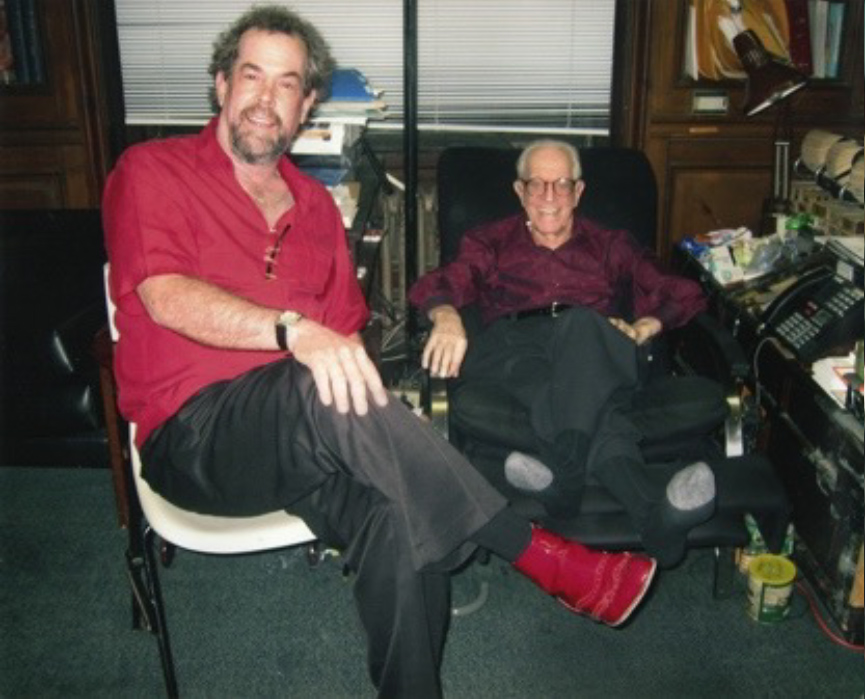
Direct Collaboration with Albert Ellis
Bernard worked at the Institute for Rational Emotive Behavior Therapy for a year as a research scientist working directly with Albert Ellis on multiple seminal publications that established REBT as applicable to childhood disorders.
Historical Significance
When Bernard began his career, REBT’s application to children was experimental and questioned. His sustained, rigorous work over four decades has established REBT as one of two major schools of cognitive-behavioral therapy (alongside Aaron Beck’s cognitive therapy) that is specifically validated for use with young populations.
Academic Credentials, Recognitions
Bernard holds exceptionally strong academic credentials.
- Emeritus Professor, California State University
- Former Professor, Melbourne Graduate School of Education; Co-Founder, Master of Educational Psychology Program
- Fellow, Albert Ellis Institute
- Licensed School Psychologist, California
- First psychologist, Collingwood Football Team (AFL)
- Cited by 6,457 scholars in academic literature, indicating substantial influence on the field
- Former, Editor-in-Chief, Journal of Rational-Emotive & Cognitive-Behavior Therapy
- Author/Editor of 50+ published books on REBT and related topics
Early Career and Innovation
Bernard began his professional career in 1979, applying REBT to children as young as five, along with their families and teachers. At the time, there was significant scepticism that REBT—a verbal and cognitive form of therapy—was unsuitable for younger populations. Alongside REBT-oriented practitioners such as Ray DiGiuseppe, Ann Vernon, and William Knaus, Bernard’s pioneering work demonstrated otherwise and fundamentally changed how REBT is applied across the lifespan.
REBT Child-Oriented Publications
These publications were groundbreaking in showing how REBT’s theoretical principles and practices could be adapted for younger populations and family systems.
- Ellis, A., & Bernard, M.E. (Eds.) (1983). Rational-Emotive Approaches to the Problems of Childhood. New York: Plenum Press, pp. 550.
- Bernard, M.E., & Joyce, M.R. (1984). Rational-Emotive Therapy with Children and Adolescents: Theory, Treatment Strategies, Preventative Methods. New York: John Wiley & Sons, pp. 520.
- Bernard, M.E. & DiGiuseppe, R. (Eds.) (1994). Rational-Emotive Consultation in Applied Settings. Hillsdale, NJ: Erlbaum, pp. 210.
- Bernard, M.E. (2004). The REBT Therapist’s Pocket Companion for Working with Children and Adolescents. New York: Albert Ellis Institute, pp. 245.
- Bernard, M.E. & Terjesen, M. (Eds.) (2020). Rational-Emotive and Cognitive-Behavioral Approaches to Child and Adolescent Mental Health: Theory, Practice, Research, Applications. Cham, Switzerland: Springer Nature, pp. 543.
Key Contributions to REBT Literature
Bernard is the author, co-author, or editor of numerous influential works.
- Bernard, M.E., & Wolfe, J. (Eds.) (2000). The REBT Resource Book for Practitioners, 2nd Edition. New York: Albert Ellis Institute, pp. 250.
- Bernard, M.E., Froh, J., DiGiuseppe, R., Joyce, M.R., & Dryden, W. (2010). Albert Ellis: Unsung hero of positive psychology. Journal of Positive Psychology, 5, 302-310.
- Bernard, M.E. (Ed.), (2013). The Strength of Self-Acceptance. New York: Springer, pp. 288.
- Bernard, M.E., & David, O. (Eds.). (2018). Coaching for Rational Living: Theory, Techniques and Applications. New York: Springer.
- Bernard, M.E., & Dryden, W. (Eds). (2019). Advances in REBT Theory, Practice, Research, Measurement, Prevention and Promotion. Cham, Switzerland: Springer Nature Switzerland AG, pp.391.
- Dryden, W., & Bernard, M.E. (Eds.). (2019) REBT with Diverse Problems and Populations. Cham, Switzerland: Springer Nature Switzerland AG, pp. 429.
Scholarly Impact: REBT Research-Measurement
Bernard’s research has been influential in establishing empirical evidence for REBT’s effectiveness, including the design and evaluation of scales of irrationality.
- Hajzler, D.J. & Bernard, M.E. (1991). A review of rational-emotive education outcome studies. School Psychology Quarterly, 6, 27-49.
- Bernard, M.E. (1998). Validation of the General Attitude and Belief Scale. Journal of Rational-Emotive & Cognitive-Behavior Therapy, 16, 184-196.
- Bernard, M.E., & Cronan, F. (1999). The Child and Adolescent Scale of Irrationality: Validation data and mental health correlates. Journal of Cognitive Psychotherapy: An International Quarterly, 13, 121-132.
- Bora, C., Bernard, M.E., & Decsei-Radu, A. (2009). Teacher irrational belief scale – Preliminary norms for Romanian population. Journal of Cognitive and Behavioral Psychotherapies, 9, 211-220.
Leadership in REBT Training and Expansion
Bernard was Co-Director of the Australian Institute for Rational Emotive Therapy. Throughout Australia and New Zealand, he has supervised and trained more than 1,000 mental health practitioners in REBT theory and practice.
Bernard REBT-Oriented Self-Help Books for General Public
Michael Bernard is unique as an academic-practitioner who shares REBT’s core concepts and tools with a general readership.
- Bernard, M.E. (2011). Rationality and the Pursuit of Happiness. The Legacy of Albert Ellis. London: Wiley-Blackwell, pp. 305.
- Bernard, M.E. (2021). The High Performance Mindset at Work, Home and Life. Melbourne, VIC: Wilkinson Publishing, pp. 293.
- Bernard, M.E., & James, H. (2025). AHA! Moments. Riding Life’s Rollercoaster Without Freaking Out. Melbourne: Wilkinson Publishers, pp. 130.
- Bernard, M.E. (2025). Procrastinate Later. Do It Now! Melbourne: Wilkinson Publishers, pp. 290.
Bernard Integrated REBT in School Social-Emotional Curricula: You Can Do It! Education
Over the past 25 years, Michael Bernard has systematically integrated REBT principles into You Can Do It! (YCDI!), transforming Ellis’s therapeutic approach into a comprehensive, developmentally appropriate social-emotional learning framework for students of all ages. This integration has produced measurable improvements in students’ social-emotional capacity, self-belief, motivation, achievement, and mental health. YCDI! has been adopted by over 5,000 early childhood, primary and secondary schools, with over 1,000,000 students participating in its programs. YCDI! curricula, integrating REBT into classroom practice, lessons, and research studies.
- Bernard, M.E., & Walton, K.E (2011). The effect of You Can Do It! Education in six schools on student perceptions of wellbeing, teaching-learning and relationships. Journal of Student Well-being, 5, 22-37.
- *Ashdown, D.M, & Bernard, M.E. (2012). Can explicit instruction in social and emotional learning skills benefit the social-emotional development, well-being, and academic achievement of young children? Early Childhood Education Journal, 39, 397-405.
- Bernard, M.E. (2017). Impact of teaching attitudes and behaviors for learning on the reading achievement of students falling behind. International Journal of Learning, Teaching and Educational Research, 16, 51-64.
- Bernard, M.E. (2023). The You Can Do It! Education Resource Book: Classroom and School-wide Practices for Social and Emotional Learning. The Bernard Group.
- Bernard, M.E. (2023). Program Achieve Early Childhood, A Social-Emotional Learning Curricula, 5th Ed. East Melbourne: The Bernard Group.
- Bernard, M.E. (2023). Program Achieve. A Social-Emotional Learning Curricula (Primary; Secondary), 5th Ed. East Melbourne: The Bernard Group.
Applications of REBT to Anti-Bullying Programs in Schools
Michael Bernard’s school-based program for 9-15-year-olds, Bullying: The Power to Cope, has introduced young people to the basic ideas of REBT, with research showing REBT’s effectiveness in helping young people change their thinking about bullying and in reducing the emotional stress of exposure to different forms of bullying.
- Markopolous, Z., & Bernard, M.E. (2015). Effect of the Bullying: The Power to Cope program on children’s response to bullying. Journal of Relationships Research, 6, 1-11
- Yamamoto, T., Matsumoto, Y., & Bernard, M.E. (2017). Effect of the cognitive-behavioral You Can Do It! Education program on the resilience of Japanese elementary school students: A preliminary investigation. International Journal of Education Research, 86, 50-58.
- Bernard, M.E. (2019). Bullying: The Power to Cope (2nd Ed.). Oakleigh: East Melbourne, VIC: The Bernard Group.
- Stewart, J., & Bernard, M.E. (2023). Empowering the victims of bullying: The ‘Bullying: The Power to Cope Program’. Journal of Evidence-Based Psychotherapies, 23, 147-172. DOI: 10.24193/jebp.2023.2.15.
Extending REBT into Work and Organisational Settings
In collaboration with Dr Dom Dimattia, senior staff supervisor at the Albert Ellis Institute, Michael Bernard has extended REBT into the world of work and organisational life, applying its core principles to stress management, leadership, performance and wellbeing. Through his High Performance Mindset at Work framework —encompassing his book, HPMW audit, and applied programs—he translates REBT into practical tools for individuals, teams, and organisations.
- Bernard, M.E. (1990). Taking the Stress Out of Teaching. Melbourne, Vic.: Collins-Dove, 1990, pp. 336.
- Bernard, M.E. (2018). Workplace stress management coaching. In M. E. Bernard & O. David (Eds.), Coaching for Rational Living. Theory, Techniques and Applications. New York: Springer Press.
- Bernard, M.E. (2018). Coaching high workplace performance. In M. E. Bernard & O. David (Eds.), Coaching for Rational Living. Theory, Techniques and Applications. New York: Springer Press.
- Bernard, M.E. (2019). REBT in the workplace. In M.E. Bernard & W. Dryden (Eds.), Advances in REBT. Theory, Practice, Research, Measurement, Prevention and Promotion. Cham, Switzerland: Springer Nature Switzerland AG, pp. 353-380.
- Bernard, M.E. (2018). Stress Management for Teachers and School Principals. A Professional Development Program. East Melbourne: The Bernard Group.
- Bernard, M.E. (2021). The High Performance Mindset at Work, Home and Life. Melbourne, VIC: Wilkinson Publishing, pp. 293.
Applications to Professional Sport
As the first sport psychologist of the Collingwood Football Team (AFL), Michael Bernard introduced players to the ABCs of REBT in pre-season, mental skills training programs and in individual coaching sessions.
- Bernard, M.E. (1985). A rational-emotive mental skills training program for professional athletes. In A. Ellis & M.E. Bernard (Eds.), Clinical Applications of Rational-Emotive Therapy. New York: Plenum Press, pp. 277-310.
Conclusion
Michael Bernard transformed REBT from a primarily adult-focused therapeutic approach into a comprehensive system applicable across the lifespan. His direct collaboration with Albert Ellis and REBT colleagues, together with his subsequent independent research and innovation, has made him one of the most significant figures in post-Ellis REBT development. He pioneered extending REBT into educational, preventative mental health, social-emotional learning, and organisational contexts—demonstrating that the core principles of Rational-Emotive Behavior Therapy could be systematically adapted and taught to younger populations in schools and in organisational settings, with measurable positive outcomes. His work represents the bridge between Ellis’s original adult-focused therapy and contemporary applications of REBT across diverse populations and settings.